Concrete is the second most consumed product in the world and one of the most widely used materials in civil construction, thanks to its versatility and strength. Even so, not everyone knows that temperature can play a critical role in its properties and performance.
In this article we look at the effects of temperature on concrete, showing how thermal variations can influence its durability, its strength and even the safety of structures.
What are the effects of temperature on concrete?
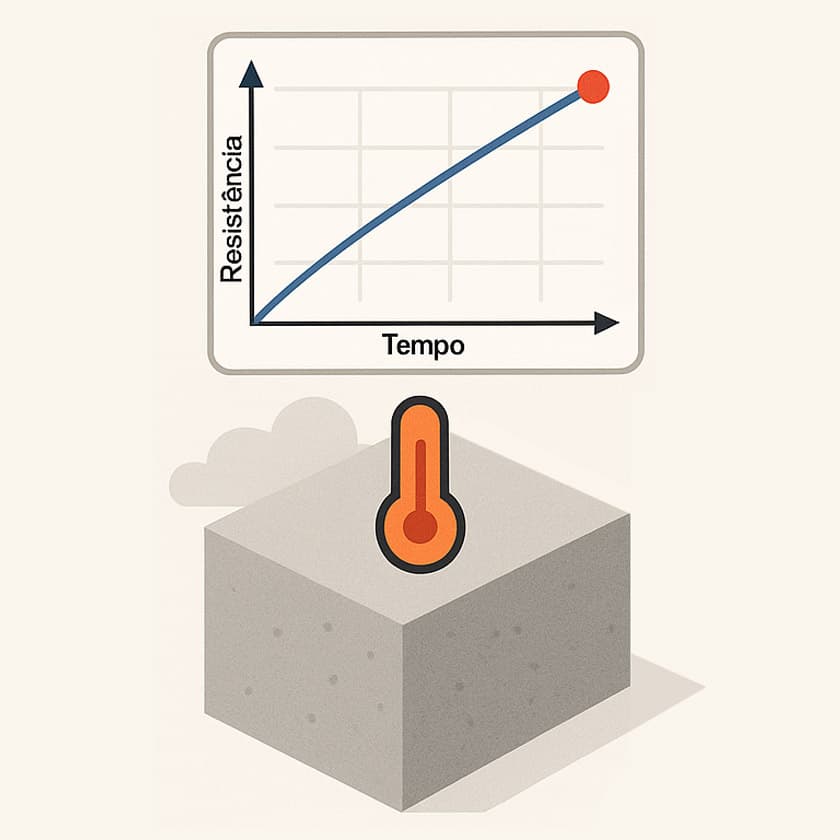
Concrete is made up of cement, water, sand, gravel and admixtures, but the reaction responsible for its hardening occurs only between two of these components: cement and water. This chemical phenomenon is exothermic and is known as the heat of hydration.
The ambient temperature has a strong influence on the heat of hydration, with both extreme heat and extreme cold being problematic. On very hot days, the heat of hydration is high, which increases water evaporation, causes the concrete to shrink and, as a result, generates cracks.
There are ways to minimize these effects, such as using admixtures or cements with additions, like CP III, which contains 35% to 70% blast furnace slag and ensures a lower heat of hydration.
On colder days, below 15 degrees Celsius, the low heat of hydration slows hardening and reduces the initial strength. This delay creates problems for anyone who needs fast formwork removal, such as factories producing precast elements and components.
It is also worth highlighting the more extreme cases, below 10 degrees Celsius and above 35 degrees Celsius. In extreme cold, besides the delay, the start of the cement set can be halted. As a result, the concrete does not react and remains in a fresh state.
In extreme heat, the set can begin while the concrete is still being transported. The branches of the cement particle that result from the reaction between cement and water begin to form, but the rotation of the truck breaks them. After placing, these branches re-establish themselves, but in a less intense way, which reduces the strength of the concrete.
For this reason, on days with temperatures above 35 degrees Celsius or below 10 degrees Celsius it is not advisable to carry out concreting. On days with high or low temperatures that are not extreme, however, it is entirely possible to do so with quality, simply paying attention to the choice of cement and admixtures.
It is important to know that measuring temperature alone does not predict future cracking, since heat is not the only factor responsible for the evaporation rate. That calculation also takes into account air humidity and wind speed at the concreting site.
How to prevent cracking in concrete?
In addition to predicting the occurrence of cracks, it is now also possible to prevent them. Some of the main measures are:
- Use cold water to cool the aggregates and thereby lower the heat of hydration.
- Use plastic film (polyethylene sheets) and, whenever possible, keep the concrete covered to reduce evaporation.
- Adopt concrete with high initial strength to better resist the tensile stresses that lead to cracking.
- Apply the flooding or ponding method, in which a small mortar barrier is formed around the concrete to retain water.
- Use water sprayers in the concreting area to increase the air humidity of the site.
- Paint the concrete mixer trucks in light colors.
There are many other methods to overcome the problem of concrete shrinkage. As long as a proper study of the local climate is carried out, a suitable concrete mix is chosen, or the concreting is rescheduled for a day with more favorable weather, there is no reason to fear cracking.